Chinese Trade Performance Exceeds Forecasts as January-February Surplus Reaches Record High
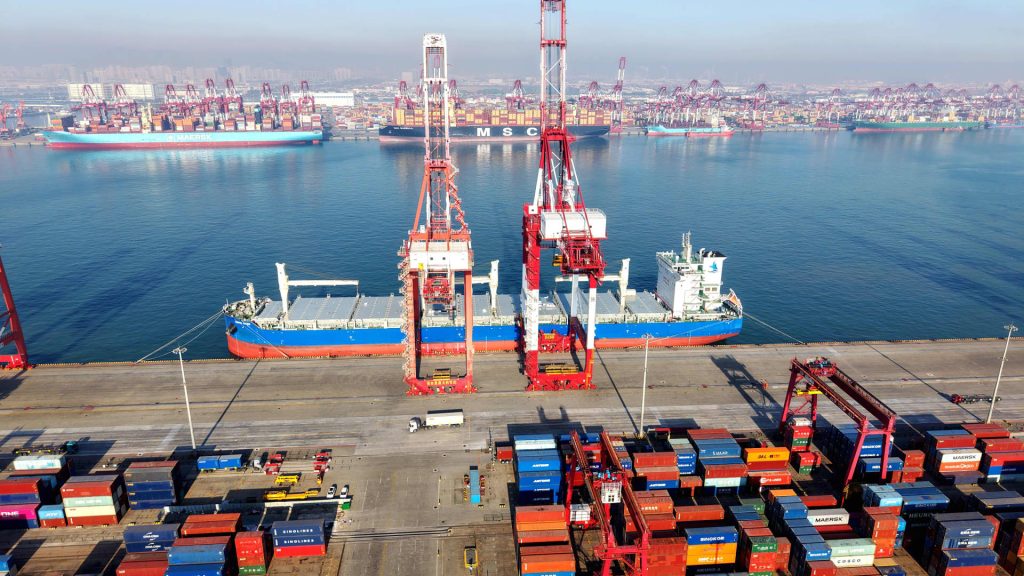
China delivered exceptional trade performance in the opening months of the year, with its trade surplus climbing to unprecedented levels while export growth dramatically outpaced analyst predictions, demonstrating the economic strength of the world’s second-largest economy amid ongoing commercial tensions with the United States.
Chinese authorities traditionally merge trade statistics for January and February to eliminate irregularities caused by the variable timing of the Lunar New Year celebrations.
The nation’s trade surplus soared to $213.62 billion during this combined period, significantly exceeding analyst projections of $179.6 billion.
Chinese exports experienced robust growth of 21.8% compared to the same period last year, substantially surpassing the 7.1% increase that economists surveyed by Reuters had anticipated.
Meanwhile, imports demonstrated strong momentum with a 19.8% year-over-year increase in the first two months, well above the expected 6.3% growth rate, according to customs authorities’ Wednesday announcement.
Official statistics revealed contrasting regional trade patterns: while commercial activity with the United States declined 16.9% to 609.71 billion yuan ($88.22 billion) compared to the previous year’s equivalent period, trade volumes with European Union nations increased 19.9% to 998.94 billion yuan. Commerce with ASEAN countries also expanded significantly, rising 20.3% to reach 1.24 trillion yuan.
These trade developments follow China’s consumer price inflation recording its most substantial increase in over three years, driven by heightened spending during an extended holiday period.
Zhiwei Zhang, president and chief economist at Pinpoint Asset Management, noted that the unexpected performance was partially attributed to the relatively late timing of the Lunar New Year holiday, which may have enhanced year-over-year growth comparisons with the previous year. Nevertheless, he emphasized that this timing factor “probably cannot fully explain the surprise.”
Zhang suggested that the robust export figures, combined with the conservative growth objectives established during Beijing’s annual “Two Sessions” policy conferences, indicate that additional economic stimulus measures are unlikely in the immediate future.
During the “Two Sessions” policy gathering, Premier Li Qiang established a GDP growth target range of 4.5% to 5%, representing the most modest target since the early 1990s.
China’s Consumer Price Index advanced 1.3% in February year-over-year, exceeding economists’ predictions of a 0.8% increase in Reuters polling.
This rise, following a 0.2% increase in January, represented the most significant recovery since January 2023.
The economic data emerges as Chinese Premier Li Qiang recognized the effects of U.S. tariffs while presenting economic objectives during Thursday’s “Two Sessions” meeting.
Beijing and Washington have remained engaged in commercial disputes since U.S. President Donald Trump resumed office in January 2025, with both nations implementing varying tariff adjustments on each other’s products throughout 2025.
Nevertheless, bilateral relations showed improvement following discussions between Trump and Xi Jinping during the APEC summit in Busan, South Korea, in October.
Current U.S. tariffs on Chinese merchandise stand at the global 10% rate after the Supreme Court invalidated Trump’s tariffs implemented under the International Emergency Economic Powers Act.
However, previous tariffs established under Section 301 of the Trade Act of 1974 and Section 232 of the Trade Expansion Act of 1962 continue to apply to certain products, with rates reaching up to 100%. Business intelligence company China Briefing reported in February that “due to the multitude of existing duties, the effective tariff rate on many Chinese goods shipped to the US remains close to 30 percent – still the highest of any country.”